14 start here
14.1 a concrete example
I think it is always best to start with a concrete example, and only later generalize to the abstract definition.
You and I are looking at a blank rectangular sheet of paper on a table. If you look away, I could to a few things with it, and when you look back, you wouldn’t be able to tell the difference.
- I could rotate the paper 180 degrees around its center, without lifting it off the table. Let’s call this operation r, for “rotation”.
- I could flip the paper over along a horizontal line that runs through its center, so that the top becomes the bottom and vice versa. Let’s call this operation h, for “horizontal flip”.
- I could flip the paper over along a vertical line that runs through its center, so that the left side becomes the right side and vice versa. Let’s call this operation v, for “vertical flip”.
- I should mention an obvious manipulation, that would be do nothing. I could leave the paper as it is. Let’s call this operation e. There is no reason to use the symbol e, that’s what everybody agreed to use. The standard name for “do nothing” is “identity”.
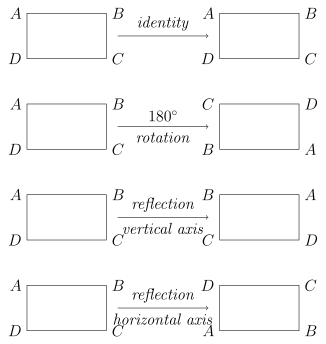
The four operations are shown in the image above, where the four corners of the rectangle are labeled to indicate which operation transforms the rectangle in which way.
All these four operations act on an object (the rectangle), and leave it unchanged. They are the symmetries of the object.
While you’re looking away, I could decide to perform two operations in sequence. For example, I could first perform a horizontal flip (h) and then a rotation (r). The result would clearly leave the rectangle unchanged from your point of view. If you look carefully at the image above, you’ll find out that the composition of these two operations is equivalent to a single operation, which is performing a vertical flip (v).
I can then ask the question: what if I try all possible compositions of these four operations?
| e | r | h | v | |
|---|---|---|---|---|
| e | e | r | h | v |
| r | r | e | v | h |
| h | h | v | e | r |
| v | v | h | r | e |
The table above is called a group table, or a Cayley table, or a multiplication table. It should be read as follows: the first operation to be executed is the one listed on the column header, and the second operation is the one listed on the row header. The cell at the intersection of the row and column gives the result of performing those two operations in sequence. For example, take the column “r” and the row “h”. We write their composition as “h * r”, where the convetion is that operations are performed from right to left. This is similar to the way we read functions in mathematics: if we have two functions f and g, we write their composition as f \circ g, which means “apply g, and then f”.
From this table we can note a few things:
- For any two operations in the table, the result of their composition is also an operation in the table. This is called closure.
- The order in which we perform three or more operations does not matter. In other words, for any three operations a, b, and c, the result of (a * b) * c is the same as a * (b * c). Let’s verify this with an example from the table: if we take the operations r, h, and v, then (r * h) * v = v * v = e, and r * (h * v) = r * r = e. Since both results are equal, the operation is associative.
- There exists an identity element in the table, which is the operation that leaves everything unchanged when performed. In this case, it’s the e operation.
- For each operation in the table, there exists another operation that, when performed after it, results in the identity element. For example, performing a rotation (r) followed by another rotation (r) results in the identity (e). Every element in the table has an inverse.
14.2 the formal definition
Now that we are familiar with a concrete example of a group (the symmetries of a rectangle), we can state the formal definition of a group.
A group is a set G together with a binary operation * (called the group operation, or simply a multiplication) that combines any two elements a and b in G to form another element in G, denoted a * b, such that the following four conditions are satisfied:
- Closure: For all a, b in G, the result of the operation a * b is also in G.
- Associativity: For all a, b, c in G, (a * b) * c = a * (b * c).
- Identity: There exists an element e in G such that for every element a in G, e * a = a * e = a. This element e is called the identity of the group.
- Inverse: For each element a in G, there exists an element b in G such that a * b = b * a = e, where e is the identity element. The element b is called the inverse of a and is usually denoted as a^{-1}.
14.3 finite groups
The example of the symmetries of a rectangle is a finite group because it has a finite number of elements (in this case, 4 elements: e, r, h, v). Its formal name is the “Klein four-group”, or V_4. Other intuitive examples of finite groups are:
The symmetries of an equilateral triangle. Its elements are the identity, three rotations, and three reflections, making a total of 6 elements. This group is known as the “dihedral group of order 6”, or D_3.
The set of integers modulo n, denoted by \mathbb{Z}/n\mathbb{Z}, with the operation of addition modulo n. This group has n elements: \{0, 1, 2, \ldots, n-1\}. The most common example of this type of group is what we use in clock arithmetic, where the numbers wrap around after reaching the maximum value. In that case, the elements are the hours on a clock (0 through 11 for a 12-hour clock), and the operation is addition modulo 12.
The simplest non-trivial group is the “cyclic group of order 2”, or C_2, which consists of two elements: the identity and one other element that is its own inverse. Examples in real life include the flip of a coin (heads or tails) or the state of a light switch (on or off). Interestingly, this same group can describe the multiplication of the numbers 1 and -1 (1 would be the identity and -1 would be the non-identity element).
e a e e a a a e
14.4 infinite groups
In contrast to finite groups, infinite groups have an infinite number of elements. A classic example of an infinite group is the set of all integers, denoted by ℤ, with the operation of addition. This group is called the “infinite cyclic group” or C_\infty. The addition of any two integers always results in another integer, demonstrating the closure property. The identity element in this group is 0, and the inverse of any integer n is -n. As for the associative property, the condition (a + b) + c = a + (b + c) holds for all integers a, b, and c.
Another example is the set of all real numbers, denoted by ℝ, with the operation of addition. This group is also infinite and is known as the “additive group of real numbers”.
14.5 discrete groups
In a discrete group, the elements are isolated from one another. There is a distinct “gap” between any two elements; you cannot smoothly slide from one element to the next.
All finite groups are discrete groups because their elements are isolated and there is a clear gap between them. Some infinite groups are also discrete, such as the group of integers with addition, where each integer is separated from the next by a gap of 1. However, not all infinite groups are discrete; for example, the group of real numbers with addition is not discrete because there are no gaps between the elements.
14.6 continuous groups
In a continuous group, the elements form a continuous space (a manifold). You can make infinitely small, smooth adjustments to move from one element to a neighboring element. Continuous groups are always infinite.
A classic example of a continuous group is the set of all real numbers with the operation of addition, which we already discussed as the “additive group of real numbers”. Another example is the group of rotations in three-dimensional space, known as the “special orthogonal group” or SO(3). This is the symmetry group of a sphere. This group consists of all rotations about the origin in 3D space, and the group operation is the composition of rotations. The elements of this group form a continuous surface (a manifold), and you can make infinitely small changes to a rotation to get a neighboring rotation. I do realize that the concept of a manifold is weird at the moment, and we will discuss it in more detail when we talk about Lie groups.