The group SL(2) is the group of 2x2 matrices with determinant 1. It is a fundamental example in the study of Lie groups and Lie algebras. The determinant of a matrix measures volume scaling. If you apply a linear transformation with matrix A to a region of space, the volume gets multiplied by \det(A). So \det=1 means volume preserving transformations. This is a very natural class of symmetries — transformations that don’t shrink or expand space, just reshape it.
Play with the widget below and and get a feel for three kinds of transformations that preserve area in 2d space: rotation, shear, and squish/stretch. The last panel shows all three operations at once.
A general element of this group can be written as:
g = \begin{pmatrix} a & b \\ c & d \end{pmatrix}
where a, b, c, d \in \mathbb{C} and the determinant is 1, i.e., ad - bc = 1.
Change of point of view. Each of the elements a,b,c,d is complex-valued, and we can imagine that every matrix in SL(2,\mathbb{C}) is a point in an 4-dimensional complex space \mathbb{C}^4 . However, the constraint that the determinant equals 1 reduces the degrees of freedom by 1, meaning that the group SL(2,\mathbb{C}) is a 3-dimensional surface embedded in a larger \mathbb{C}^4. If you prefer to think of 1 complex dimension as equivalent to 2 real dimensions, then just multiply all the dimensions by 2. This surface is curved, because of the nonlinear constraint ad - bc = 1. In mathematical parlance, we call this surface a manifold.
11.2 tangent space
Let’s parametrize each element of the 2x2 matrix in SL(2) with the variable t:
We can imagine that this parametrization defines a general curve in the manifold of SL(2). We will require that this curve passes through the identity element of SL(2) at t = 0:
What we will do now is to take the derivative of this curve with respect to the parameter t, which will give us a vector in the tangent space of SL(2) at each point:
\dot{g}(t) = \begin{pmatrix} \dot{a}(t) & \dot{b}(t) \\ \dot{c}(t) & \dot{d}(t) \end{pmatrix},
where the dot means “time derivative”.
Let’s now compute the derivative of the condition ad - bc = 1 with respect to t, and evaluate it at t = 0:
For convenience, we will call the tangent vector of g(t) at the identity X.
Let’s take stock of what happened. From Calculus (and Physics), we are used to the idea that taking the time-derivative of the position curve gives us a vector for the velocity. The velocity is tangent to the displacement curve at each point. That’s exactly what we did here, but we did it for all possible curves in the manifold that pass through the identity element of SL(2). By taking the derivative of the curves A(t) at t = 0 (at the identity element), we obtained vectors in the tangent space of SL(2) at that point. These new vectors have exactly the same dimension as the original (in this case 3 complex dimensions), but they live in a flat (Euclidean) space rather than in the curved manifold of SL(2).
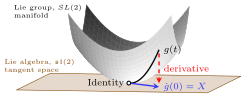
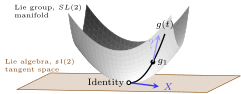
The curved gray surface represents the manifold of SL(2), and the plane below it represents the tangent space at the identity element. An element in the manifold gets mapped by the derivative to a point in the tangent space.
11.3 back and forth between the group and the tangent space
We’ve seen that, starting from a curve g(t), we can get to an element of the tangent space X by taking its derivative at the identity:
g(t) \xrightarrow[]{\frac{d}{dt}} X.
How do we go back? Starting from X in the tangent space, how to get the curve g in the manifold? The answer is: exponentiation!
X \xrightarrow[]{\exp} g(t).
Let’s see how this works. X is a 2\times2 matrix, and its (parametric)exponential is
This is exactly the same formula for the exponent of scalars, but applied to matrices. Note that the identity matrix I takes the role of the number 1. The matrix X raised to any power is still a 2\times2 matrix. Therefore, the series above also gives as a result a 2\times2 matrix. Now, how can we know if this new matrix “lands” in the manifold, where the group elements live? We just need to check if the determinant of \exp(tX) is 1, if it is, we’re golden.
And this shows that exponentiating an element of the tangent space brings us to a curve g(t) in the manifold.
The proof is water tight, but somewhat not satisfying. I guessed that the solution was the exponential, and verified that it does the job. Why should the exponential appear in the first place?
The previous analogy between position and velocity will be useful. If a particle has position x(t) and constant velocity v, then for a very small time step \Delta t
v \approx \frac{x(t+\Delta t)-x(t)}{\Delta t}.
Rearranging,
x(t+\Delta t) \approx x(t) + \Delta t \cdot v.
So in ordinary Euclidean space, constant velocity means that each small time step updates the position by
x(t)\longmapsto x(t)+\Delta t\cdot v
The same idea works for a Lie group, except that the update operation is no longer addition. In a group, motions are composed by multiplication. Therefore, the analogue of adding a small displacement is multiplying by a small group element near the identity.
If g(t) is a curve in the manifold for which g(0)=I and \dot{g}(t)=X, we can rewrite its derivative by using the definition
We’ve reached the same result as before, but this time the exponential appears naturally from the derivation.
To sum up: taking the derivative of a curve g(t) in the manifold gives us the element X in the tangent space. Exponentiating X brings us back to g(t).
11.4 wait, what?
Is this correct? The derivative and the exponential are lanes travelling in opposite directions in the same road? Usually, we have the following pairs: (\exp,\log) and (\text{derivative},\text{integral}). Did we not just mix elements of these two pairs?
I will show now that, in a sense, taking the derivative or the log of a group element is the same. Conversely, exponentiating or integrating an element in the tangent space give the same result.
11.4.1 derivative = log
Let’s take a group element g close to the identity. We can write it as
g = I + \Delta t X + O(\Delta t^2),
where X is some matrix and \Delta t is small. Taking the log:
\log(g) = \log(I + \Delta t X + O(\Delta t^2)).
We now use the Taylor series for the log:
\log(g) = \log(I+\Delta t X) = \Delta t X - \frac{(\Delta t X)^2}{2} + \frac{(\Delta t X)^3}{3} - \ldots = \Delta t X + O(\Delta t^2).
To leading order in \Delta t, the log simply gives back \Delta t X, which is exactly the tangent vector X, up to the small parameter \Delta t.
Both the derivative and the log do the same job, they extract the linear part of the deviation from the identity. Differentiation gives the exact geometric definition for what the tangent space is, while the logarithm is a computational shortcut, it extracts the tangent vector from a specific point near the identity, without needing a whole curve in the manifold.
11.4.2 integral = exp
We’ve seen before that the rule for taking small steps along a curve g(t) is
It says that g(t) is not any curve on the manifold that passes through the identity. This is the one curve whose velocity at any point is proportional to itself!
Of course, we can solve this first-order differential equation by integrating it, giving what we found before: g(t)=\exp(tX). Thus we have shown that, in a sense, integration and exponentiation give the same thing.
11.5 the tangent space is a vector space
A vector space has the following property: if A and B are two vectors in the vector space, their linear combination \mu_1 A + \mu_2 B is also a vector belonging to this vector space. The one condition we know about the tangent space is that its elements are 2\times2 matrices with trace zero. So let’s use that to prove that our tangent space is a vector space. Using the fact that the trace operation is linear:
\text{trace}(\mu_1 A + \mu_2 B) = \mu_1 \underbrace{\text{trace}(A)}_{=0} + \mu_2 \underbrace{\text{trace}(B)}_{=0} = 0.
If you want to see this in extra detail, let’s write
An algebra is a vector space equipped with a special operation. The natural operation of vector spaces is the addition: you can add two vectors and get another vector. That’s not what I’m talking about. The extra operation also takes two vectors and return a third vector. What should this extra operation be? The answer is related to a concept we have not discussed yet: commutativity
11.7 commutativity
Putting one’s socks on, and then the shoes, is not the same as putting the shoes on and then the socks. The order of operations often matters.
When the order of two operations doesn’t affect the result, we say that the operations commute. Simple examples are the sum and product of two numbers
Maybe you’re thinking: “There are not two operations in the example above, there is only one sum and one product, one for each example! The numbers commute, not the operations!” Sure, this is a legitimate way of seeing things. Another way is to, in the summation example, see every number as its own summation operation, being applied on a “test element” x not shown. Let me spell out how this looks:
+3+5+x = +5+3+x = +15+x.
The same goes for the product: 2\cdot 7\cdot x = 7\cdot 2\cdot x.
11.8 non-commutativity
Of course, non-commutativity is the name we give to operations whose order does affect the result. I’ll give a concrete example here using rotations, and it turns out that this will be super useful to us. Rotations in 3d space are a special case inside the bigger Lie group SL(2). I’ll use rotations because this is something we have lots of intuition on from day-to-day experience.
We will talk about rotation using the image of Earth. See the widget below.
On the left we see Earth with a head-on view of the equator, centered at the meridian 75E, making India right at the center.
On the center we can slide the slider labeled g(t), to spin Earth to the right (eastward), so that by the end of the slider Earth has rotated 75 degrees, and now we see the zero meridian at Greenwich at the center.
On the right we can slide the slider labeled k(t), to tilt Earth counter-clockwise on the plane of the screen where you’re seeing this image, so that by the end of the slider Earth has tilted 23.44 degrees.
The question now is: does the order or operations matter? Spinning to the right and then tilting is the same as the opposite order? Let’s see this in action. In the widget below:
On the globe on the left, first slide A(t) on the top and then B(t) at the bottom.
On the globe on the right, slide first B(t) and then A(t).
Show the code
{const W=280, H=340, R=115, cx=W/2, cy=165, ext=40, gap=20;const BG='#dddddd', OCEAN='#84a1b7', π=Math.PI;// ── explicit 3×3 rotation matrices in the fixed observer frame ────────────// screen/view convention:// x = viewing direction, y = screen horizontal, z = screen vertical//// a = Rz: eastward rotation around the fixed screen-vertical axis// b = Rx: tilt/roll around the fixed viewing axis, so the pole tilts in screen planefunctionRz(deg) {const c=Math.cos(deg*π/180), s=Math.sin(deg*π/180);return [[c,-s,0],[s,c,0],[0,0,1]]; }functionRx(deg) {const c=Math.cos(deg*π/180), s=Math.sin(deg*π/180);return [[1,0,0],[0,c,-s],[0,s,c]]; }functionmul(A,B) {const C=[[0,0,0],[0,0,0],[0,0,0]];for(let i=0;i<3;i++) for(let j=0;j<3;j++) for(let k=0;k<3;k++) C[i][j]+=A[i][k]*B[k][j];return C; }functionapplyM(M, lon, lat) {const φ=lat*π/180, λ=lon*π/180;const x=Math.cos(φ)*Math.cos(λ);const y=Math.cos(φ)*Math.sin(λ);const z=Math.sin(φ);const rx=M[0][0]*x+M[0][1]*y+M[0][2]*z;const ry=M[1][0]*x+M[1][1]*y+M[1][2]*z;const rz=M[2][0]*x+M[2][1]*y+M[2][2]*z;return [Math.atan2(ry,rx)*180/π,Math.asin(Math.max(-1,Math.min(1,rz)))*180/π ]; }const INIT =Rz(-75);functionmakeSlider(label, min, max, step, init) {const wrap=document.createElement('div'); wrap.style.cssText='margin-bottom:5px';const lbl=document.createElement('label'); lbl.textContent=label; lbl.style.cssText='color:black;font-family:Arial,sans-serif;font-size:13px;'+'font-weight:bold;display:block;margin-bottom:1px';const inp=document.createElement('input'); inp.type='range'; inp.min=min; inp.max=max; inp.step=step; inp.value=init; inp.style.cssText='width:100%;display:block;cursor:pointer;margin:0'; wrap.append(lbl,inp);return {wrap,inp}; }const {wrap:wLA,inp:iLA}=makeSlider('g(t)',0,75,1,0);const {wrap:wLB,inp:iLB}=makeSlider('k(t)',0,23.44,0.1,0);const {wrap:wRB,inp:iRB}=makeSlider('k(t)',0,23.44,0.1,0);const {wrap:wRA,inp:iRA}=makeSlider('g(t)',0,75,1,0);const container=document.createElement('div'); container.style.cssText=`background:${BG};padding:8px;display:flex;`+`gap:${gap}px;width:${2*W+gap+16}px;box-sizing:border-box;align-items:flex-start`;const colL=document.createElement('div'); colL.style.cssText=`width:${W}px;flex-shrink:0`;const svgL=d3.create('svg').attr('width',W).attr('height',H).style('background',BG).node(); colL.append(wLA,wLB,svgL);const colR=document.createElement('div'); colR.style.cssText=`width:${W}px;flex-shrink:0`;const svgR=d3.create('svg').attr('width',W).attr('height',H).style('background',BG).node(); colR.append(wRB,wRA,svgR); container.append(colL,colR);functiondraw(svgNode, M) {const svg=d3.select(svgNode); svg.selectAll('*').remove();const fn=(lon,lat)=>applyM(M,lon,lat);const baseProj=d3.geoOrthographic().scale(R).translate([cx,cy]).rotate([0,0,0]);const customProj={stream(sink){const ps=baseProj.stream(sink);return {point(lon,lat){const [rl,rp]=fn(lon,lat); ps.point(rl,rp); },lineStart(){ ps.lineStart(); },lineEnd(){ ps.lineEnd(); },polygonStart(){ ps.polygonStart(); },polygonEnd(){ ps.polygonEnd(); },sphere(){ if(ps.sphere) ps.sphere(); } }; } };const path=d3.geoPath(customProj);functionproject(lon,lat){const [rl,rp]=fn(lon,lat);returnbaseProj([rl,rp]); }const npPx=project(0,90)??[cx,cy-R];const spPx=project(0,-90)??[cx,cy+R];const dx=npPx[0]-spPx[0];const dy=npPx[1]-spPx[1];const len=Math.sqrt(dx*dx+dy*dy)||1;const ux=dx/len;const uy=dy/len;const poleDepth=M[0][2];const eps=0.01;functiondrawAxisSegment(parent, polePx, sign) {const tx=polePx[0]+sign*ux*ext;const ty=polePx[1]+sign*uy*ext; parent.append('line').attr('x1',polePx[0]).attr('y1',polePx[1]).attr('x2',tx).attr('y2',ty).attr('stroke','#e17701').attr('stroke-width',2.5); parent.append('circle').attr('cx',tx).attr('cy',ty).attr('r',3.5).attr('fill','#e17701'); }// draw the back-facing axis segment first, so the globe occludes itif(poleDepth > eps){drawAxisSegment(svg, spPx,-1); } elseif(poleDepth <-eps){drawAxisSegment(svg, npPx,1); } svg.append('circle').attr('cx',cx).attr('cy',cy).attr('r',R).attr('fill',OCEAN); svg.append('path').datum(d3.geoGraticule().step([15,90])()).attr('fill','none').attr('stroke','rgba(200,200,200,0.40)').attr('stroke-width',0.7).attr('d',path); svg.append('path').datum({type:'LineString',coordinates:d3.range(-180,181,1).map(l=>[l,0])}).attr('fill','none').attr('stroke','rgba(255,255,180,0.35)').attr('stroke-width',1).attr('d',path); svg.append('path').datum(topojson.feature(world,world.objects.land)).attr('fill','#2d6a1f').attr('d',path); svg.append('path').datum(topojson.mesh(world,world.objects.countries)).attr('fill','none').attr('stroke','rgba(255,255,255,0.35)').attr('stroke-width',0.5).attr('d',path); svg.append('circle').attr('cx',cx).attr('cy',cy).attr('r',R).attr('fill','none').attr('stroke','rgba(0,0,0,0.20)').attr('stroke-width',1);// draw the front-facing axis segment last, so it appears to emerge from the globeif(poleDepth > eps){drawAxisSegment(svg, npPx,1); } elseif(poleDepth <-eps){drawAxisSegment(svg, spPx,-1); } else {drawAxisSegment(svg, npPx,1);drawAxisSegment(svg, spPx,-1); }}// ── stateful ambient-frame updates ────────────────────────────────────────//// important:// slider values are not recomputed into a fresh matrix.// instead, each slider movement applies the delta since the previous value.// this preserves the historical order in which the user moved the sliders.const stateL = {M: INIT,A:+iLA.value,B:+iLB.value };const stateR = {M: INIT,A:+iRA.value,B:+iRB.value };functionredraw(){draw(svgL,stateL.M);draw(svgR,stateR.M); } iLA.addEventListener('input',() => {const next=+iLA.value;const delta=next-stateL.A; stateL.M=mul(Rz(delta),stateL.M); stateL.A=next;redraw(); }); iLB.addEventListener('input',() => {const next=+iLB.value;const delta=next-stateL.B; stateL.M=mul(Rx(delta),stateL.M); stateL.B=next;redraw(); }); iRA.addEventListener('input',() => {const next=+iRA.value;const delta=next-stateR.A; stateR.M=mul(Rz(delta),stateR.M); stateR.A=next;redraw(); }); iRB.addEventListener('input',() => {const next=+iRB.value;const delta=next-stateR.B; stateR.M=mul(Rx(delta),stateR.M); stateR.B=next;redraw(); });redraw();return container;}
Did you get the same thing? No! If you think there’s something suspicious with this simulations, just take any object around you and try it yourself. I recomment doing 90-degree rotations because it’s just easier to keep track of what’s going on.
The conclusion: the order of operation matters when we’re dealing with rotations.
11.9 quantifying the non-commutativity
Ok, the order of operation matters, but how much? Is the difference barely perceptible, or super consequential? How to quantify it? We are wondering, “is gk equal to kg?”
gk \stackrel{?}{=} kg
In order to find the difference between the two sides of the equation, ideally I would subtract the same quantity from both sides. Unfortunately, groups only have multiplication and the inverse, not addition/subtraction. To measure the effect of doing operations in different orders, we right-multiply both sides of the equation by g^{-1} and then right-multiply again by k^{-1}. We get:
gkg^{-1}k^{-1} \stackrel{?}{=} I.
Conjugations of group operations are read right-to-left, so the left-hand side above, called group commutator, says: “apply k^{-1}, then g^{-1}, then k and finally g. The question mark on top of the equal sign is asking:”if we did all that, would the final result bring us back home, to our starting place?”
Let’s see that in action with globe rotations. Slide each of the sliders from top to bottom and see if the result equals to the unchanged globe on the right.
Show the code
{const W=280, H=340, R=115, cx=W/2, cy=165, ext=40, gap=20;const BG='#dddddd', OCEAN='#84a1b7', π=Math.PI;// ── explicit 3×3 rotation matrices in the fixed observer frame ────────────// screen/view convention:// x = viewing direction, y = screen horizontal, z = screen vertical//// g = Rz: eastward rotation around the fixed screen-vertical axis// k = Rx: tilt/roll around the fixed viewing axis, so the pole tilts in screen planefunctionRz(deg) {const c=Math.cos(deg*π/180), s=Math.sin(deg*π/180);return [[c,-s,0],[s,c,0],[0,0,1]]; }functionRx(deg) {const c=Math.cos(deg*π/180), s=Math.sin(deg*π/180);return [[1,0,0],[0,c,-s],[0,s,c]]; }functionmul(A,B) {const C=[[0,0,0],[0,0,0],[0,0,0]];for(let i=0;i<3;i++) for(let j=0;j<3;j++) for(let k=0;k<3;k++) C[i][j]+=A[i][k]*B[k][j];return C; }functionapplyM(M, lon, lat) {const φ=lat*π/180, λ=lon*π/180;const x=Math.cos(φ)*Math.cos(λ);const y=Math.cos(φ)*Math.sin(λ);const z=Math.sin(φ);const rx=M[0][0]*x+M[0][1]*y+M[0][2]*z;const ry=M[1][0]*x+M[1][1]*y+M[1][2]*z;const rz=M[2][0]*x+M[2][1]*y+M[2][2]*z;return [Math.atan2(ry,rx)*180/π,Math.asin(Math.max(-1,Math.min(1,rz)))*180/π ]; }const INIT =Rz(-75);functionmakeSlider(label, min, max, step, init) {const wrap=document.createElement('div'); wrap.style.cssText='margin-bottom:5px';const lbl=document.createElement('label'); lbl.innerHTML=label; lbl.style.cssText='color:black;font-family:Arial,sans-serif;font-size:13px;'+'font-weight:bold;display:block;margin-bottom:1px';const inp=document.createElement('input'); inp.type='range'; inp.min=min; inp.max=max; inp.step=step; inp.value=init; inp.style.cssText='width:100%;display:block;cursor:pointer;margin:0'; wrap.append(lbl,inp);return {wrap,inp}; }functionmakeHiddenSliderSpacer(label, min, max, step, init) {const {wrap}=makeSlider(label, min, max, step, init); wrap.style.visibility='hidden'; wrap.style.pointerEvents='none';return wrap; }const {wrap:wLKi,inp:iLKi}=makeSlider('k<sup>−1</sup>(t)',0,23.44,0.1,0);const {wrap:wLGi,inp:iLGi}=makeSlider('g<sup>−1</sup>(t)',0,75,1,0);const {wrap:wLK,inp:iLK}=makeSlider('k(t)',0,23.44,0.1,0);const {wrap:wLG,inp:iLG}=makeSlider('g(t)',0,75,1,0);const container=document.createElement('div'); container.style.cssText=`background:${BG};padding:8px;display:flex;`+`gap:${gap}px;width:${2*W+gap+16}px;box-sizing:border-box;align-items:flex-start`;const colL=document.createElement('div'); colL.style.cssText=`width:${W}px;flex-shrink:0`;const svgL=d3.create('svg').attr('width',W).attr('height',H).style('background',BG).node(); colL.append(wLKi,wLGi,wLK,wLG,svgL);const colR=document.createElement('div'); colR.style.cssText=`width:${W}px;flex-shrink:0`;const svgR=d3.create('svg').attr('width',W).attr('height',H).style('background',BG).node(); colR.append(makeHiddenSliderSpacer('k<sup>−1</sup>(t)',0,23.44,0.1,0),makeHiddenSliderSpacer('g<sup>−1</sup>(t)',0,75,1,0),makeHiddenSliderSpacer('k(t)',0,23.44,0.1,0),makeHiddenSliderSpacer('g(t)',0,75,1,0), svgR ); container.append(colL,colR);functiondraw(svgNode, M) {const svg=d3.select(svgNode); svg.selectAll('*').remove();const fn=(lon,lat)=>applyM(M,lon,lat);const baseProj=d3.geoOrthographic().scale(R).translate([cx,cy]).rotate([0,0,0]);const customProj={stream(sink){const ps=baseProj.stream(sink);return {point(lon,lat){const [rl,rp]=fn(lon,lat); ps.point(rl,rp); },lineStart(){ ps.lineStart(); },lineEnd(){ ps.lineEnd(); },polygonStart(){ ps.polygonStart(); },polygonEnd(){ ps.polygonEnd(); },sphere(){ if(ps.sphere) ps.sphere(); } }; } };const path=d3.geoPath(customProj);functionproject(lon,lat){const [rl,rp]=fn(lon,lat);returnbaseProj([rl,rp]); }const npPx=project(0,90)??[cx,cy-R];const spPx=project(0,-90)??[cx,cy+R];const dx=npPx[0]-spPx[0];const dy=npPx[1]-spPx[1];const len=Math.sqrt(dx*dx+dy*dy)||1;const ux=dx/len;const uy=dy/len;const poleDepth=M[0][2];const eps=0.01;functiondrawAxisSegment(parent, polePx, sign) {const tx=polePx[0]+sign*ux*ext;const ty=polePx[1]+sign*uy*ext; parent.append('line').attr('x1',polePx[0]).attr('y1',polePx[1]).attr('x2',tx).attr('y2',ty).attr('stroke','#e17701').attr('stroke-width',2.5); parent.append('circle').attr('cx',tx).attr('cy',ty).attr('r',3.5).attr('fill','#e17701'); }// draw the back-facing axis segment first, so the globe occludes itif(poleDepth > eps){drawAxisSegment(svg, spPx,-1); } elseif(poleDepth <-eps){drawAxisSegment(svg, npPx,1); } svg.append('circle').attr('cx',cx).attr('cy',cy).attr('r',R).attr('fill',OCEAN); svg.append('path').datum(d3.geoGraticule().step([15,90])()).attr('fill','none').attr('stroke','rgba(200,200,200,0.40)').attr('stroke-width',0.7).attr('d',path); svg.append('path').datum({type:'LineString',coordinates:d3.range(-180,181,1).map(l=>[l,0])}).attr('fill','none').attr('stroke','rgba(255,255,180,0.35)').attr('stroke-width',1).attr('d',path); svg.append('path').datum(topojson.feature(world,world.objects.land)).attr('fill','#2d6a1f').attr('d',path); svg.append('path').datum(topojson.mesh(world,world.objects.countries)).attr('fill','none').attr('stroke','rgba(255,255,255,0.35)').attr('stroke-width',0.5).attr('d',path); svg.append('circle').attr('cx',cx).attr('cy',cy).attr('r',R).attr('fill','none').attr('stroke','rgba(0,0,0,0.20)').attr('stroke-width',1);// draw the front-facing axis segment last, so it appears to emerge from the globeif(poleDepth > eps){drawAxisSegment(svg, npPx,1); } elseif(poleDepth <-eps){drawAxisSegment(svg, spPx,-1); } else {drawAxisSegment(svg, npPx,1);drawAxisSegment(svg, spPx,-1); } }// ── stateful ambient-frame updates ────────────────────────────────────────//// important:// slider values are not recomputed into a fresh matrix.// instead, each slider movement applies the delta since the previous value.// this preserves the historical order in which the user moved the sliders.const stateL = {M: INIT,Ki:+iLKi.value,Gi:+iLGi.value,K:+iLK.value,G:+iLG.value };functionredraw(){draw(svgL,stateL.M);draw(svgR,INIT); } iLKi.addEventListener('input',() => {const next=+iLKi.value;const delta=next-stateL.Ki; stateL.M=mul(Rx(-delta),stateL.M); stateL.Ki=next;redraw(); }); iLGi.addEventListener('input',() => {const next=+iLGi.value;const delta=next-stateL.Gi; stateL.M=mul(Rz(-delta),stateL.M); stateL.Gi=next;redraw(); }); iLK.addEventListener('input',() => {const next=+iLK.value;const delta=next-stateL.K; stateL.M=mul(Rx(delta),stateL.M); stateL.K=next;redraw(); }); iLG.addEventListener('input',() => {const next=+iLG.value;const delta=next-stateL.G; stateL.M=mul(Rz(delta),stateL.M); stateL.G=next;redraw(); });redraw();return container;}
Now it’s time to quantify by how much the result we got on the left if different from that on the right. The sliders g and k applied rotations of 75 and 23.44 degrees, respectively. We will quantify the group commutator by taking infinitesimal rotations. Taking advantage of the fact that we can express group elements and the exponentiation of the tangent space elements, we will write
g = \exp(\epsilon A),\qquad k = \exp(\epsilon B),
where is a small parameter. If g(t)=\exp(tA), then think of g = \exp(\epsilon A) as leaving from the identity and following the curve g(t) for a very small time interval \epsilon. The group commutator then reads
\begin{align*}
gkg^{-1}k^{-1} =& e^{\epsilon A}e^{\epsilon B}e^{-\epsilon A}e^{-\epsilon B} \\
=& (I + \epsilon A + \tfrac{\epsilon^2}{2} A^2 \ldots) \times \\
=& (I + \epsilon B + \tfrac{\epsilon^2}{2} B^2 \ldots) \times \\
=& (I - \epsilon A + \tfrac{\epsilon^2}{2} A^2 \ldots) \times \\
=& (I - \epsilon B + \tfrac{\epsilon^2}{2} B^2 \ldots) \\
=& \\
\text{order }\epsilon^0:&\quad I + \\
\text{order }\epsilon^1:&\quad \epsilon(A+B-A-B) + \\
\text{order }\epsilon^2:&\quad \epsilon^2(AB-A^2-AB-BA-B^2+AB + \\
&\quad \phantom{\epsilon^2(}\tfrac{\epsilon^2}{2} A^2+\tfrac{\epsilon^2}{2} B^2+\tfrac{\epsilon^2}{2} A^2+\tfrac{\epsilon^2}{2} B^2 ) + \\
&\text{higher order terms in }\epsilon
\end{align*}
All the terms in order \epsilon^1 cancel out, and many of the terms in order \epsilon^2 cancel out too, but not all. The result is:
gkg^{-1}k^{-1} = I + \epsilon^2\left(AB-BA\right) + O(\epsilon^3)
So now we can answer our question: how different is the group commutator from the identity? The difference is small, but not zero. There are no terms of order \epsilon, while the terms of order \epsilon^2 give a nice expression, AB-BA. Because A and B are elements of the algebra, we call this the algebra commutator, and we express it with the square brackets [A,B], called Lie brackets.
We can now go back to talking about why the tangent space we found is “an algebra”. We showed that the tangent space is a vector space. This is the first requirement. The second, is that this vector space is equipped with an extra operator that takes to elements in the vector space and returns another element in the space. This special operator is the Lie bracket [A,B]=AB-BA. We have to show that the result also lives in the tangent space. We will remember that any element in the tangent space is a 2\times 2 matrix with trace zero, so let’s compute AB-BA explicitly:
The Lie algebra associated with \mathrm{SL}(2,\mathbb C) is denoted \mathfrak{sl}(2,\mathbb C). It is the tangent space to \mathrm{SL}(2,\mathbb C) at the identity. Its elements are the infinitesimal motions that start at I and remain inside the group, at least to first order.
Concretely,
\mathfrak{sl}(2,\mathbb C)
=
\left\{
X=
\begin{pmatrix}
a&b\\
c&-a
\end{pmatrix}
:
a,b,c\in\mathbb C.
\right\}.
This is why \mathfrak{sl}(2,\mathbb C) is 3-dimensional: it has three free parameters, a,b,c.
The algebra also has its own version of a commutator. If X,Y\in\mathfrak{sl}(2,\mathbb C), we define
[X,Y]=XY-YX.
This is called the Lie bracket. It measures the infinitesimal failure of commutativity.
11.12 a basis for \mathfrak{sl}(2)
Since all elements in the \mathfrak{sl}(2) algebra have three free parameters, we can define a convenient basis for this space, made of three basis elements:
E = \begin{pmatrix}0&1\\0&0\end{pmatrix},\quad
H = \begin{pmatrix}1&0\\0&-1\end{pmatrix},\quad
F = \begin{pmatrix}0&0\\1&0\end{pmatrix}
All three vectors are traceless, and any element in the algebra can be thought of as a linear combination of them:
\begin{align*}
[H,E] &= 2E \\
[H,F] &= -2F \\
[E,F] &= H
\end{align*}
You know this is important, because I put it in a box.
11.13 representations
Remember the operations in the very first widget in this page. We had a square, and we could spin in, shear it, or squish/stretch it. All these maintain the area, and mathematically this is enforced by the requirement that the determinant of elements in the group SL(2) equals one.
Rotations, shear and squish/stretch are abstract concepts, and they only get embodied in a specific form once we define on which kind of objects they are operating on. Take rotations, for example. If we are talking about rotating an object in 2d space, this is accomplished by a 2\times 2 matrix. If, instead, we wish to rotate an object in 3d space, that matrix won’t do, we’ll need a 3\times3 matrix to do it. The abstract notion of “rotation” needs to be represented by different things depending on the object it operates on.
So far we’ve started to get to know the group SL(2) and its tangent algebra \mathfrak{sl}(2), and now it’s time to get acquainted with a few of their representations. Both groups and algebras have representations, but in what follows we will deal with representation of the algebra. Let me try to justify why this makes sense.
A representation of the group tells us how finite transformations act. Think of a specific rotation by a given angle \theta:
We can retrieve the full family in the group by exponentiation:
R(\theta) = e^{\theta j}.
Because the algebra element j was achieved by calculating the tangent vector infinitesimally close to the identity, we call algebra elements infinitesimal generators. The equation above shows how they generate group elements.
So instead of studying every finite rotation separately, we study the generator j. The generator contains the local rule for how the rotation starts, and exponentiation recovers the finite motion. This is true not only for rotations, but for all other kinds of transformations contained in SL(2).
Another reason to study the representations of the algebra instead of representations of the group is that the algebra is a flat space, while the group is a curved manifold. Linear algebra is easier than curved geometry.
11.14 what is a representation
A representation is a translation rule. Imagine I show you a picture of a dog, and ask you to say what it represents out loud. You could say: “Sure, I’ll say it, but in what language? English? Tagalog? Guarani? Choose one and I’ll do it!” So the translation needs to convert an abstract idea (the image of a dog, or the element of the algebra) into a specific word in the target languague, or to a specific matrix in the target n-dimensional space. Let’s write this in mathematical language.
X \mapsto \rho(X): V \rightarrow V
Let’s read this out loud. Take an element X of the Lie algebra. The representation \rho turns X into an operator \rho(X). That operator takes a vector v\in V and produces another vector \rho(X)v \in V. If V is n-dimensional, then the operator \rho(X) will be a square n\times n matrix, so that it can operate on column vectors v of size n.
There is another important thing to know. We called \mathfrak{sl}(2) and algebra and not simply a vector space because it is equipped with the bracket operation: [X,Y]=XY-YX. When we use the representation \rho to map algebra elements X to linear operators \rho(X), we have to make sure that this mapping respects the bracket:
\rho([X,Y])= \rho(X)\rho(Y) - \rho(Y)\rho(X).
In other words, if two elements have a certain bracket relation in the algebra, their representative matrices must satisfy the same relation.
You might be wondering: we’ve already seen that the basis elements of \mathfrak{sl}(2) as 2\times2 matrices. How can they be anything else now? If we want the algebra elements to operate on vectors in a 5-dimensional space, then the representation will produce versions of these algebra elements as 5\times 5 matrices. So which is it?
Now that we worked hard deriving everything, climbing our way through the development of the \mathfrak{sl}(2) algebra and the commutation relation of its basis elements, it is time to get rid of the ladder we used to climb and not cling to previous concepts. We used concrete 2\times2 matrices to derive the relations
\begin{align*}
[H,E] &= 2E \\
[H,F] &= -2F \\
[E,F] &= H.
\end{align*}
Now that we know this, we can turn the argument around and say that these relations are not derived from something else. These relations define the \mathfrak{sl}(2) algebra. We stop thinking of E,H,F as 2\times2 matrices, they are now just abstract, ethereal basis elements, that respect the relations above. We could have started with these relations, but I guess it would be deeply unsatisfying to impose these commutation relations of abstract elements without any justification. We developed them naturally from first principles. But now it’s time to grow up and understand the \mathfrak{sl}(2) algebra for what it is: A vector space with three base elements, with a bracket operation [X,Y]=XY-YX, and the basis elements respect the commutation relations above. That’s it.
The roadmap now is the following. We will study three representations of the \mathfrak{sl}(2) algebra. We will see how elements of this algebra operate on vectors in a vector space of size 1, 2 and then 3.
11.15 the trivial representation
We start with a 1-dimensional vector space.
In one dimension, every linear transformation is just multiplication by a scalar, therefore the representation must be like this:
\rho(E)=a_E,\quad \rho(H)=a_H,\quad \rho(F)=a_F,
where a_E,a_H,a_F are scalars (or 1\times1 matrices). But scalars and 1\times1 matrices always commute, so for any X,Y
The only way to preserve the bracket relations in one dimension is for every generator to act as zero. Therefore the only 1D representation of \mathfrak{sl}(2) is the trivial representation.
11.16 the standard representation
Let’s see how elements of the algebra act on vectors in a 2d vector space. We need to choose a basis for this 2d space, so let’s choose:
We now need a translation rule, how to represent the basis elements of the algebra, E,H,F, as 2\times2 matrices? We’re in luck, because we can just use the 2\times2 matrices we used in the section “a basis for \mathfrak{sl}(2)”:
\begin{align*}
E &\mapsto \rho_{\text{std}}(E) = \begin{pmatrix}0&1\\0&0\end{pmatrix} \\
H &\mapsto \rho_{\text{std}}(H) = \begin{pmatrix}1&0\\0&-1\end{pmatrix} \\
F &\mapsto \rho_{\text{std}}(F) = \begin{pmatrix}0&0\\1&0\end{pmatrix}
\end{align*}
More generally, we can write that the representation is the following conversion rule for arbitrary elements X in the algebra, being acted on arbitrary vectors v in a 2d vector space:
\rho_{\text{std}}(X)v = Xv.
The X on the left-hand side denotes an abstract element of the algebra, while the X on the right-hand side denotes a concrete 2\times2 matrix.
One big advantage of the standard representation is that we don’t even have to verify whether the expression
[\rho(X),\rho(Y)] = \rho(X)\rho(Y)-\rho(Y)\rho(X)
holds for any two basis elements of the algebra, we already did that before.
It is in this sense that the standard representation is “standard”. The elements of the algebra act as 2\times2 matrices, the very same size they were originally developed in. Attention: when developing the tangent space and its basis elements, we said that it is a 3d complex-valued space, because each 2\times2 matrix as only 3 degrees of freedom. However, when interpreting these 2\times2 matrices as linear operators, we see them as acting on 2\times1 vectors, that is, vectors on a 2d space.
How will the basis elements of the algebra, E,H,F, act on the two basis vectors v_0,v_1? Let’s see:
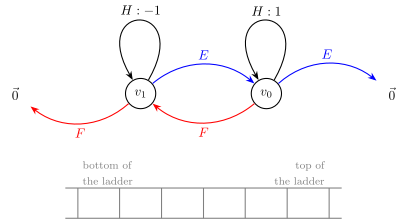
We can summarize these results in the following diagram.
The circles represent the basis vectors v_0, v_1.
Blue arrows: The action of applying the linear transformation \rho(E) on v_1 gives v_0, and applying \rho(E) on v_0 gives zero.
Red arrows: Similarly for \rho(F), it “brings” v_0 to v_1, and v_1 to zero.
Black arrows: the basis vectors v_0 and v_1 are the eigenvectors of \rho(H), with eigenvalues 1 and -1, respectively.
On the bottom of the image I put a ladder, with v_0 at its top and v_1 at its bottom. Right now it doesn’t make much sense to think of a ladder with only two rungs, but you can already think ahead and see where we’re going: representations in higher-dimensional spaces will give a ladder with more rungs, and the picture will become clearer.
Now, let’s move on to the next representation
11.17 the adjoint representation
In this representation, elements of the algebra are represented as linear operators (matrices) that operate on vectors in a 3d vector space. We need to define a basis for this space. In the 2d case of the standard representation, we chose the basis v_0=(1\,0)^T and v_1=(0\,1)^T. It would be natural to choose this time the basis
But that’s not what we will do. Instead, we already have a perfectly good basis to choose from, the three algebra elements E,H,F themselves!
This can feel truly weird and baffling. The elements E,H,F are at once:
The basis vectors of a 3d vector space.
The linear operators that operate on the basis vectors.
Actually, the second point is not quite precise. It’s not the elements E,H,F themselves that are the linear operators, but their adjoint representations: \rho_\text{adj}(E),\rho_\text{adj}(H),\rho_\text{adj}(F).
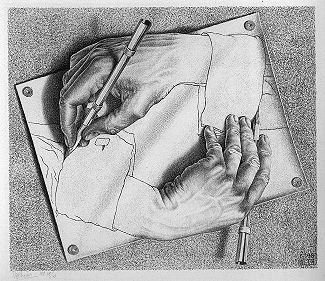
The special feature of the adjoint representation is that (representations of) elements in the algebra act on themselves. Choose your prefered metaphor here: a snake biting its own tail, a person lifting themselves by their bootstraps, or, my preferred, Escher’s Drawing Hands.
To determine the exact translation rule \rho_\text{adj}, that converts abstract algebra elements into 3\times3 matrices, we ask the question:
How should an algebra element X act on another algebra element Y?
Again, we perform the ultimate “reduce, reuse, recycle” act in the whole of Mathematics, and we use the special operation that makes \mathfrak{sl}(2) rise above being simply a vector space and become an algebra: the bracket. That is to say, how does (the representation of) X act on an element Y? Like this:
\rho_\text{adj}(X)Y = [X,Y]
Another common way to write the same thing is
\text{ad}_X(Y) = [X,Y].
Let’s find out the precise expression of the 3\times3 matrices representing each of the elements E,H,F. For that, we need two things.
assume we want to know how the representations of the elements E,H,F act on a generic vector Y in this 3d space:
Y = aE + bH + cF.
On the right-hand side, we used E,H,F as basis vectors that span the 3d space, therefore Y is simply a linear combination of them. If we determine that the basis vectors are always ordered like E,H,F, we can express the vector Y as
Y = \begin{pmatrix}a\\b\\c\end{pmatrix}.
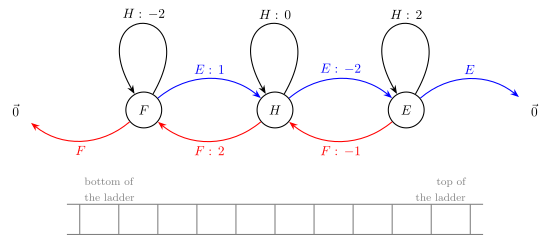
I’ll come back to the image of the ladder introduced in the standard representation. I want to know how each of the operators \text{ad}_E,\text{ad}_H,\text{ad}_F acts on each of the basis vectors E,H,F:
Of course, the this is exactly the same information as we obtained in the 3\times3 matrices we’ve just derived. Picture each outcome above as a column vector and you’ll understand why.
11.18 irreducible representations
We have now seen three representations of \mathfrak{sl}(2): the 1D trivial representation, the 2D standard representation, and the 3D adjoint representation. These are not just isolated examples. They are the first three irreducible representations of \mathfrak{sl}(2). Irreducible means that the representation cannot be decomposed into smaller invariant pieces. In the ladder picture, this means the ladder is connected from bottom to top by the actions of E and F.